
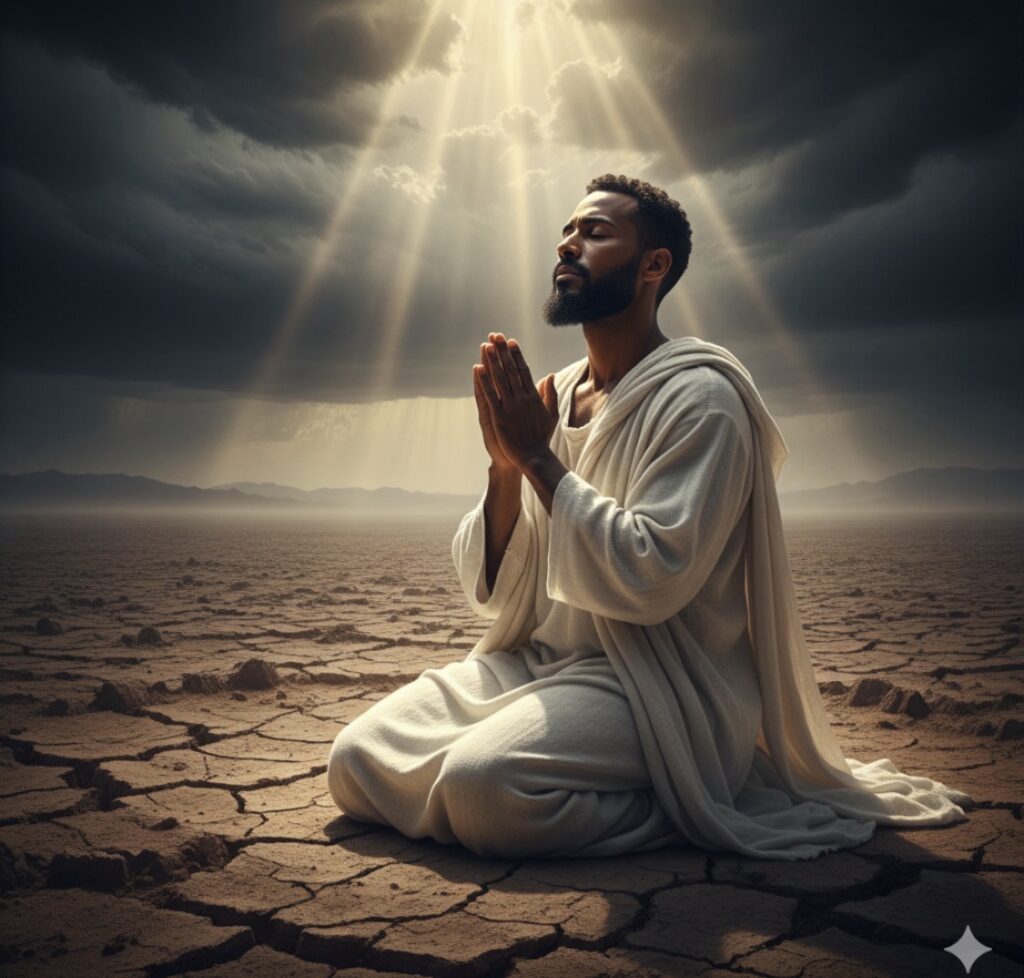
How Jesus Walked Into the Wilderness to Finish What a
Nation Could Not
It is Lent season.And right now, millions of believers around the world are fasting alongside the memory of a Man who went forty days without food in one of the most desolate places on earth — not as a spiritual discipline, but as a divine assignment.
Before we talk about what Jesus did in the wilderness,
we need to talk about why He was there at all.
Because if you miss the why, you miss everything.
The Blueprint Before the Building
Here is something most people never teach you about the Bible:
The Old Testament is not just history. It is a shadow.
And a shadow only exists because something real is casting it.
Every event, every person, every journey recorded in the Old Testament was a prophetic outline — a rough sketch — of something the Father was building toward. The shadow was never the point. The shadow was always pointing to the point.
And nowhere is this more stunning than in the life of Jesus.
A Nation Failed the Test. One Man Came to Retake It.
Fifteen hundred years before Jesus ever set foot in the wilderness, an entire nation walked out of Egypt on the greatest supernatural exit in human history. The Red Sea split. Pharaoh’s army drowned. The people of God walked through on dry ground — free, delivered, chosen.
And then God led them straight into the desert.
That nation was called the son of God — not metaphorically, but officially. In Exodus 4:22, God looks at Pharaoh and says plainly: “Israel is my son, my firstborn.”
God’s son. Set free by miracle. Chosen by covenant.
And they failed catastrophically.
Forty years in the wilderness. Forty years of grumbling, idolatry, rebellion, and unbelief. A generation that saw miracles and still couldn’t trust the God who performed them. A nation that heard God’s voice and still chose Egypt in their hearts.
The shadow was tragic. The sketch was broken.
But the real thing was coming.
Geography Is Theology
Now watch this carefully.
Jesus comes up from the waters of the Jordan River after His baptism — the same way Israel came up from the waters of the Red Sea. At that baptism, the Father tears open heaven and declares for all to hear: “This is my beloved Son.”
God’s Son. Set free from nothing. Chosen before creation.
And then — the Holy Spirit doesn’t lead Him to a palace. Doesn’t lead Him to Jerusalem. Doesn’t lead Him to comfort or celebration.
The Spirit drives Him into the wilderness.
This is not an accident. In the Bible, geography is theology. Where something happens tells you what is happening. Jesus is not wandering. He is retracing. Step by step, He is walking the exact path that His ancestors walked — because He came to finish what they couldn’t.
And just as Israel spent forty years in the wilderness,
Jesus spends forty days.
This is not coincidence. The prophet Ezekiel revealed the prophetic formula: a day for a year. Every single day Jesus fasted in the desert represented one year of Israel’s wilderness failure. He was compressing fifteen centuries of national collapse into forty days of personal victory.
The true Son had arrived to retake the test the first son had failed.
The Weapon Was Always the Word
Before we look at the three tests, notice something extraordinary about the weapon Jesus chose.
Every single time the enemy came,
Jesus responded with one book.
Not the Psalms. Not the Prophets.
Deuteronomy.
Why Deuteronomy?
Because Deuteronomy is Moses’ final address to Israel — a detailed, painful record of every way the nation had failed God in the wilderness. It was essentially their failing report card.
And Jesus picked it up like a sword.
He was saying something deeply intentional with every quote:
“You see where they stumbled? Watch me stand. You see where they fell? Watch me hold. Their every failure becomes my victory — written in the same ink, on the same pages, from the same book.”
The shadow nation’s failure. The true Son’s triumph.
Old Testament sketch. New Testament reality.
Test One: The Appetite
The enemy comes to a Man who has not eaten in forty days and points to a field of stones.
“If you are the Son of God — turn these stones into bread.”
Notice what he’s really saying. He’s not just offering food.
He is attacking an identity and weaponizing an appetite.
This was the oldest tactic in existence. In Eden, the serpent asked Eve, “Did God really say?” — targeting identity, offering appetite. In the wilderness, Israel wept and rioted because they missed the food of Egypt — their flesh overruled their faith. Throughout all of human history, the flesh has been the first door the enemy knocks on.
And he knocks on it again here.
But Jesus reaches for Deuteronomy 8:3 —
the very chapter where Moses reminded Israel of how God fed them with manna to teach them that physical bread was never the real source of life.
Jesus says: “Man does not live on bread alone, but on every word that comes from the mouth of God.”
He is not just quoting Scripture. He is demonstrating it.
He is a Man who hasn’t eaten in forty days — and He is more sustained by the Father’s word than He is desperate for food. He is living proof of the very verse He’s quoting.
Where Israel’s appetite destroyed them, Jesus’ consecration defines Him.
The shadow failed. The reality holds.
Test one — passed.
Test Two: The Presumption
The enemy shifts tactics. He takes Jesus to the highest point of the temple and offers Him a spectacle.
“Jump. The angels will catch you. Prove God is with you.”
And hidden inside this temptation is an ancient wound.
In the wilderness at a place called Massah, Israel grew thirsty and turned on Moses with a question that became one of the most heartbreaking lines in the entire Old Testament:
“Is the Lord among us or not?”
They had seen the plagues. Crossed the sea. Eaten bread that fell from the sky. And still — they needed God to prove Himself. They wanted to dictate the terms of His presence. They wanted a God who performed on command.
The enemy is now offering Jesus the same trap:
Force the Father’s hand. Make Him prove He loves you. Design your own miracle.
Jesus doesn’t take the bait.
He reaches for Deuteronomy 6:16 — again, the very verse that referenced Israel’s failure at Massah — and says:
“You shall not put the Lord your God to the test.”
He doesn’t need a spectacle to know the Father loves Him.
He heard it at the Jordan. He holds it in His heart.
He trusts what was spoken more than what He can manufacture.
Where Israel demanded proof, Jesus rests in trust.
The shadow failed. The reality holds.
Test two — passed.
Test Three: The Worship
The enemy makes his final move. He takes Jesus to a high mountain, gestures at every kingdom of the world shimmering below them, and makes an offer:
“One act of worship. One bow. And all of this is yours.”
Meanwhile, fifteen hundred years earlier, at the foot of a different mountain, while Moses was in the presence of God receiving the Law — the people of Israel grew impatient. They couldn’t see God. They couldn’t control God. So they melted their gold, shaped a calf, and bowed.
They gave their worship to the enemy.
They exchanged the living God for something they could manage.
Now the enemy stands before the true Son of God and asks for the same exchange.
And Jesus, one final time, opens Deuteronomy —
chapter six, verse thirteen:
“Worship the Lord your God and serve Him only.”
No negotiation. No hesitation. No compromise.
Where the nation bowed to the shadow, the Son stands for the reality.
Test three — passed.
What Just Happened
An entire nation — called God’s son, covered in miracles, carrying the covenant — spent forty years failing three tests in the wilderness.
One Man — hungry, alone, fully human — passed all three in forty days.
Every Old Testament shadow had been pointing here.
Every wilderness story had been rehearsing this moment.
Every failure of Israel had been setting the stage for this victory.
Jesus didn’t just survive the wilderness.
He reversed fifteen hundred years of inherited defeat.
And here is why that matters to you:
You are not in Christ as someone who still owes a debt to the wilderness.
You are in Christ as someone represented by the One who conquered it.
His obedience is your inheritance.
His victory is your identity.
His passing the test is the reason you are no longer defined by yours.
One Final Shadow
After the tests are finished and the enemy retreats —
where does Jesus go?
He goes up a mountain.
And if you know your Old Testament, that detail should stop you cold.
Because the last Man who came out of a wilderness experience
and went up a mountain
came back down carrying the Word of God for a new generation.
His name was Moses.
The shadow is still speaking.
And the reality is still far greater than anyone imagined.
This Lent season, as you fast — remember what you are participating in. You are not just going without food. You are joining the memory of the One who went without food and refused to let hunger define His devotion.
Fast from your appetite.
Feed on His word.
And let the reality eclipse every shadow.
erness Was Always His to Win
It is Lent season.
And right now, millions of believers around the world are fasting alongside the memory of a Man who went forty days without food in one of the most desolate places on earth — not as a spiritual discipline, but as a divine assignment.
Before we talk about what Jesus did in the wilderness,
we need to talk about why He was there at all.
Because if you miss the why, you miss everything.
The Blueprint Before the Building
Here is something most people never teach you about the Bible:
The Old Testament is not just history. It is a shadow.
And a shadow only exists because something real is casting it.
Every event, every person, every journey recorded in the Old Testament was a prophetic outline — a rough sketch — of something the Father was building toward. The shadow was never the point. The shadow was always pointing to the point.
And nowhere is this more stunning than in the life of Jesus.
A Nation Failed the Test. One Man Came to Retake It.
Fifteen hundred years before Jesus ever set foot in the wilderness, an entire nation walked out of Egypt on the greatest supernatural exit in human history. The Red Sea split. Pharaoh’s army drowned. The people of God walked through on dry ground — free, delivered, chosen.
And then God led them straight into the desert.
That nation was called the son of God — not metaphorically, but officially. In Exodus 4:22, God looks at Pharaoh and says plainly: “Israel is my son, my firstborn.”
God’s son. Set free by miracle. Chosen by covenant.
And they failed catastrophically.
Forty years in the wilderness. Forty years of grumbling, idolatry, rebellion, and unbelief. A generation that saw miracles and still couldn’t trust the God who performed them. A nation that heard God’s voice and still chose Egypt in their hearts.
The shadow was tragic. The sketch was broken.
But the real thing was coming.
Geography Is Theology
Now watch this carefully.
Jesus comes up from the waters of the Jordan River after His baptism — the same way Israel came up from the waters of the Red Sea. At that baptism, the Father tears open heaven and declares for all to hear: “This is my beloved Son.”
God’s Son. Set free from nothing. Chosen before creation.
And then — the Holy Spirit doesn’t lead Him to a palace. Doesn’t lead Him to Jerusalem. Doesn’t lead Him to comfort or celebration.
The Spirit drives Him into the wilderness.
This is not an accident. In the Bible, geography is theology. Where something happens tells you what is happening. Jesus is not wandering. He is retracing. Step by step, He is walking the exact path that His ancestors walked — because He came to finish what they couldn’t.
And just as Israel spent forty years in the wilderness,
Jesus spends forty days.
This is not coincidence. The prophet Ezekiel revealed the prophetic formula: a day for a year. Every single day Jesus fasted in the desert represented one year of Israel’s wilderness failure. He was compressing fifteen centuries of national collapse into forty days of personal victory.
The true Son had arrived to retake the test the first son had failed.
The Weapon Was Always the Word
Before we look at the three tests, notice something extraordinary about the weapon Jesus chose.
Every single time the enemy came,
Jesus responded with one book.
Not the Psalms. Not the Prophets.
Deuteronomy.
Why Deuteronomy?
Because Deuteronomy is Moses’ final address to Israel — a detailed, painful record of every way the nation had failed God in the wilderness. It was essentially their failing report card.
And Jesus picked it up like a sword.
He was saying something deeply intentional with every quote:
“You see where they stumbled? Watch me stand. You see where they fell? Watch me hold. Their every failure becomes my victory — written in the same ink, on the same pages, from the same book.”
The shadow nation’s failure. The true Son’s triumph.
Old Testament sketch. New Testament reality.
Test One: The Appetite
The enemy comes to a Man who has not eaten in forty days and points to a field of stones.
“If you are the Son of God — turn these stones into bread.”
Notice what he’s really saying. He’s not just offering food.
He is attacking an identity and weaponizing an appetite.
This was the oldest tactic in existence. In Eden, the serpent asked Eve, “Did God really say?” — targeting identity, offering appetite. In the wilderness, Israel wept and rioted because they missed the food of Egypt — their flesh overruled their faith. Throughout all of human history, the flesh has been the first door the enemy knocks on.
And he knocks on it again here.
But Jesus reaches for Deuteronomy 8:3 —
the very chapter where Moses reminded Israel of how God fed them with manna to teach them that physical bread was never the real source of life.
Jesus says: “Man does not live on bread alone, but on every word that comes from the mouth of God.”
He is not just quoting Scripture. He is demonstrating it.
He is a Man who hasn’t eaten in forty days — and He is more sustained by the Father’s word than He is desperate for food. He is living proof of the very verse He’s quoting.
Where Israel’s appetite destroyed them, Jesus’ consecration defines Him.
The shadow failed. The reality holds.
Test one — passed.
Test Two: The Presumption
The enemy shifts tactics. He takes Jesus to the highest point of the temple and offers Him a spectacle.
“Jump. The angels will catch you. Prove God is with you.”
And hidden inside this temptation is an ancient wound.
In the wilderness at a place called Massah, Israel grew thirsty and turned on Moses with a question that became one of the most heartbreaking lines in the entire Old Testament:
“Is the Lord among us or not?”
They had seen the plagues. Crossed the sea. Eaten bread that fell from the sky. And still — they needed God to prove Himself. They wanted to dictate the terms of His presence. They wanted a God who performed on command.
The enemy is now offering Jesus the same trap:
Force the Father’s hand. Make Him prove He loves you. Design your own miracle.
Jesus doesn’t take the bait.
He reaches for Deuteronomy 6:16 — again, the very verse that referenced Israel’s failure at Massah — and says:
“You shall not put the Lord your God to the test.”
He doesn’t need a spectacle to know the Father loves Him.
He heard it at the Jordan. He holds it in His heart.
He trusts what was spoken more than what He can manufacture.
Where Israel demanded proof, Jesus rests in trust.
The shadow failed. The reality holds.
Test two — passed.
Test Three: The Worship
The enemy makes his final move. He takes Jesus to a high mountain, gestures at every kingdom of the world shimmering below them, and makes an offer:
“One act of worship. One bow. And all of this is yours.”
Meanwhile, fifteen hundred years earlier, at the foot of a different mountain, while Moses was in the presence of God receiving the Law — the people of Israel grew impatient. They couldn’t see God. They couldn’t control God. So they melted their gold, shaped a calf, and bowed.
They gave their worship to the enemy.
They exchanged the living God for something they could manage.
Now the enemy stands before the true Son of God and asks for the same exchange.
And Jesus, one final time, opens Deuteronomy —
chapter six, verse thirteen:
“Worship the Lord your God and serve Him only.”
No negotiation. No hesitation. No compromise.
Where the nation bowed to the shadow, the Son stands for the reality.
Test three — passed.
What Just Happened
An entire nation — called God’s son, covered in miracles, carrying the covenant — spent forty years failing three tests in the wilderness.
One Man — hungry, alone, fully human — passed all three in forty days.
Every Old Testament shadow had been pointing here.
Every wilderness story had been rehearsing this moment.
Every failure of Israel had been setting the stage for this victory.
Jesus didn’t just survive the wilderness.
He reversed fifteen hundred years of inherited defeat.
And here is why that matters to you:
You are not in Christ as someone who still owes a debt to the wilderness.
You are in Christ as someone represented by the One who conquered it.
His obedience is your inheritance.
His victory is your identity.
His passing the test is the reason you are no longer defined by yours.
One Final Shadow
After the tests are finished and the enemy retreats —
where does Jesus go?
He goes up a mountain.
And if you know your Old Testament, that detail should stop you cold.
Because the last Man who came out of a wilderness experience
and went up a mountain
came back down carrying the Word of God for a new generation.
His name was Moses.
The shadow is still speaking.
And the reality is still far greater than anyone imagined.